Guide for ExhibitorsGeneral Exhibits Regulations
PDF Download
1. Area Configuration and Specification Comparison
| Area characteristics | An exhibition area where you can broadly promote your technologies, products, and services through freely designed booths. | |
|---|---|---|
| Participation format | Standard Booth | Small Package Booth |
| Eligible exhibitors | Corporations/organizations *Entities that conform to the "5‑1 Exhibit Categories" defined in the Exhibition Regulations |
|
| Booth location selection | Yes (first-come, first-served) |
|
| Booth size | Frontage width 3 m × Depth 3 m per booth | Frontage width 2 m × Depth 2 m per booth |
| Height limit | Depends on booth scale (Please refer to "4. Exhibition Area, Number of Booths Applied for, Height Restrictions"). |
2.7 m |
| Package booth provided | No | Yes |
| Application unit | 1–100 booths | 1–2 booths |
| Exhibition fee (tax included) | Organizer / Co-organizer Members JPY 396,000 per booth General corporations/organizations JPY 440,000 per booth |
JPY 220,000 per booth |
| Primary feeder line work + electricity fee | No (JPY 13,200/kW applied separately) |
Yes (up to 1 kW/booth free of charge) |
| Exhibitor badges | 15 per booth | 15 per booth |
| Worker ribbons | 5 per booth | 5 per booth |
| Invitation Leaflet (application required / free allocation) | Depends on booth scale | Up to 1,000 cards |
| Opening reception invitations | Allocation varies by booth scale | 3 invitations |
| Logo on venue map | △ (only for exhibitors with 20+ booths) |
- |
| Conference speaking slot (500 seats) | Not included / Paid option | Not included / Paid option |
| In-park stage speaking slot (100 seats) | Not included / Paid option | Not included / Paid option |
| Pre-interviews by media partners | No | No |
| Visitor Information Acquisition System | Not included / Paid option | Not included / Paid option |
| Mail magazine Ads | Not included / Paid option | Not included / Paid option |
| Official website banner Ads (standard banner) | Not included / Paid option | Not included / Paid option |
Services marked as "Not included / Paid option" are available for an additional fee upon application.
2. Exhibition Fees and Plans
2-1. General Exhibits
| ♦Standard Booth Participation Space: 1 to 100 booths |
Per booth as follows: Organizer / Co-organizer Members: JPY 396,000 per booth (including consumption tax) General corporations/organizations: JPY 440,000 per booth (including consumption tax) |
|---|---|
| ♦Small Package Booth (supplied with equipment package) |
1 booth: JPY 220,000 (including consumption tax) 2 booths: JPY 440,000 (including consumption tax) |
Note: Within the exhibition venue, the space lent to exhibitors is referred to as a "booth" or "stall."
Organizer / Co-organizer Members are members of the Japan Electronics and Information Technology Industries Association (JEITA), the Communications and Information network Association of Japan (CIAJ), and the Software Association of Japan (SAJ) (including supporting members, etc.).
-
Standard Booths
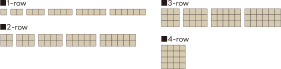
1 booth to 18 booths (single-row to four-row booth specifications)
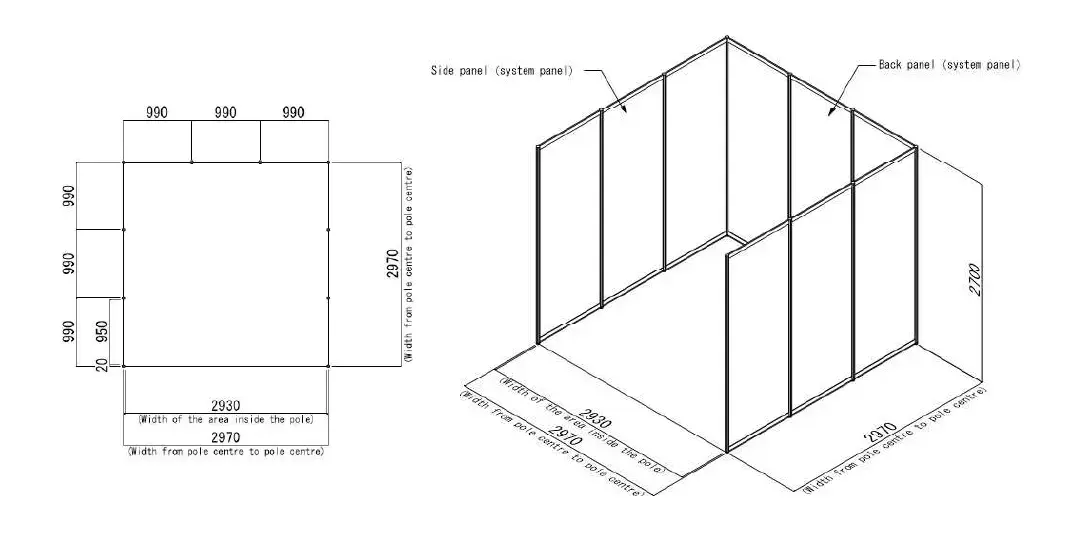
Click image to enlarge - 1 booth specifications: Frontage width 3m × Depth 3m
- Panels on the rear side (system panels) and on sides adjacent to other exhibitors will be installed as basic panels. System panels will not be installed on the aisle side of corner booths or on booths that are independent booths.
- Exhibitors are responsible for providing their own floor carpeting, company name boards, other materials, decorations, etc. It is also possible to use the various package booths that will be introduced separately.
- If you are exhibiting in booths 1 to 18, one to three sides of your booth may be adjacent to other companies.
- It is prohibited to display company names or logos facing the other booths that are adjacent to you.
20 booths or more (block booths)
- The standard size of a block booth is 9㎡.
- The booth dimensions will be calculated from the total area of the number of booths multiplied by 9㎡. The width to depth ratio will be between 2:1 and 1:1, and will be indicated on the booth allocation drawing at the booth location selection meeting.
- Exhibitors must install carpeting, etc. in the designated space and construct the booth in a way that visitors can see the boundary between the aisle and the booth.
Please refer to "4. Exhibition Area, Number of Booths Applied for, Height Restrictions" for height restrictions when constructing the booth.
-
Small Package Booth
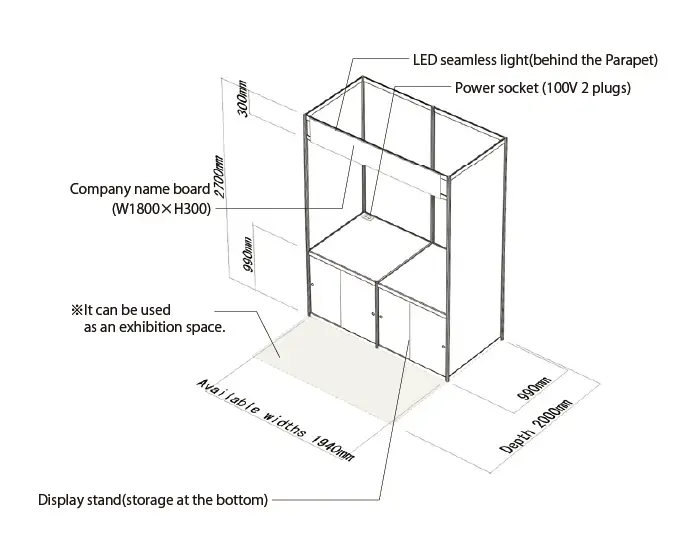
- 1 booth standard: 2m (width) × 2m (depth) × 2.7m (height)
-
Decoration specifications
- Display stand (990mm (depth) × 975mm (height) with storage space at the bottom)
- Basic wall
- Company name cutting sheet
- Company name parapet (300mm wide)
- Primary line construction and electricity usage (up to 1kW free of charge)
- Outlet (single-phase 100V power supply up to 1kW capacity)
- LED seamless light
- Exhibitor can apply for one/two booths
Any modifications to the package booth (including changes to panel sizes or removal of panels), as well as any booth construction that may affect surrounding booths, are not permitted.
Click image to enlarge
3. Notes on Exhibition Fees
3-1. Costs included in the exhibition booth fee
| Exhibitor badges |
15 badges per booth If you require more than the standard number of badges, you can purchase additional ones at 1,650 JPY per badge (including consumption tax) |
|
|---|---|---|
| Worker ribbons |
5 ribbons per booth If you require more than the standard number of ribbons, you can purchase additional ones at 550 JPY per ribbon (including consumption tax) |
|
| Invitation leaflets (by application) |
1–3 booths 4–8 booths 9–12 booths 15–20 booths For booths beyond 20 (each additional 5 booths) |
Up to 1,000 cards Up to 2,500 cards Up to 4,000 cards Up to 6,000 cards 1,200 cards will be added for each additional 5 booths |
| If you require more than the standard number of cards, you can purchase additional cards at 330 JPY per card (including consumption tax) | ||
| Opening Reception Invitation |
1–3 booths 4–8 booths 9–12 booths 15–20 booths Each additional 5 booths |
3 invitations 5 invitations 10 invitations 15 invitations Increase by 2 invitations |
For details, please refer to the "Exhibitor Manual" to be distributed in July.
3-2. Costs that will definitely be incurred in addition to the exhibition fee
The following costs are not included in the exhibition fee, as well as booth decorations other than the basic panel.
|
Primary line construction fee (including electricity usage fee) The secondary line construction fee for items such as power outlets in the booth is not included. This fee is included in the exhibition fee for small package booths. |
JPY 13,200/kW (including consumption tax) |
|---|
3-3. Other Optional Paid Services Menu Items
| Utility booth (9m²) | 1 unit JPY 264,000 (including consumption tax) |
|---|---|
| Packaged display | JPY 110,000– (including consumption tax) |
| Visitor's lead scanning system | JPY 30,800– (including consumption tax) * |
| Internet connection | JPY 110,000– (including consumption tax) * |
| Invitation Leaflet | JPY 3,300 per card (including consumption tax) * |
The items listed above are common examples of optional services based on FY2025 reference prices. For full details and pricing, please refer to the Exhibitor Manual, scheduled for release in July.
4. Number of Booths Applied for, Height Restrictions
4-1. General Exhibits
| Type of Booth | Booth Layout | Number of Booths Applied for | Height Restrictions The height of the basic panels is 2.7m, and the following height restrictions apply. |
|---|---|---|---|
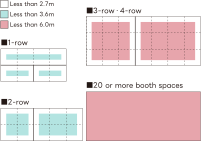
| Standard Booths | Single-row booths | 1, 2, 3, 4, 5, 6 | The area 1m set back from the aisle and basic panels can be used up to a height of 3.6m. |
| Double-row booths | 4, 6, 8, 10 | ||
| Triple-row booths | 9, 12, 15, 18 |
The area set back 1m from the aisle and the basic panels can be used up to a height of 6m.
If the number of booths applied for by a group exhibition is 20 or more in double-row booth format, the height restrictions for triple-and quad-row booths will apply. |
|
| Four-row booths | 16 | ||
| Block booth | 20, 25, 30, 35, 40, 45, 50, 55, 60, 65, 70, 75, 80, 85, 90, 95, 100 | The full height of the booth can be used up to 6m. For block booths, hanging structures are possible up to 6m in height. Please note that the installation location of hanging structures must be confirmed with the venue (Makuhari Messe) in advance. | |
| Small Package Booths | Single-row booths | 1, 2 | 2.7m |
- Single-row to four-row booths may have one to three sides that touch booths from other companies.
- If you are exhibiting jointly with other companies or as part of an industry group, you may apply for more than the maximum of 100 booths.
For applications exceeding 100 booths, please consult the CEATEC management office. - After the application deadline, the Organizing Committee will determine the venue layout, and if the venue capacity is insufficient, adjustments may be made to reduce the number of booths allocated to each exhibitor based on fair criteria. In such cases, we ask for the understanding of all exhibitors.
The height restrictions for exhibits and decorations are as stated above. However, if the height of an exhibit exceeds the height limit due to the nature of the exhibit, please submit a "Request for Height Exceeding Exhibit Product" and booth design plans (floor plan and elevation) to the CEATEC Management Office at a later date and obtain permission from the Organizing Committee. In this case, the exhibits must be displayed within the exhibitor's booth (the area set back 1m from the aisle and basic panels), and may not extend into the aisle or other areas. It is prohibited to apply any decorations such as company names or product names on exhibits that have received permission to exceed the height limit.
| Booth Form | Height Limit |
|---|---|
|
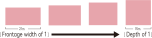
■ Block BoothBlock booths have a standard area of 9m² per booth. The booth dimensions are calculated from the total area (9m² × number of booths), with the width-to-depth ratio between 2:1 and 1:1, and will be indicated on the drawing at the booth location selection meeting. Please note that requests for specific booth dimensions cannot be accommodated. ● Example dimensions when applying for 25 boothsTotal area 225m² (9m² × 25 booths): Dimensions are calculated within the range from a rectangle with a wider frontage to a square, and will be indicated on the drawing.
|
The above diagram is a top-view floor plan of the booth. |
5. Exhibit Categories, Booth Location Decisions, Exhibit Applications and Contracts
5-1. Eligible exhibitors
The following types of companies and organizations can exhibit at CEATEC, handling products from the following categories or conducting business related to them.
- IT and electronics equipment-related
- Electronic components, devices, materials, equipment-related
- Broadcasting and information and communications related
- Software and content related
- Automobile and mobility related
- Public infrastructure related
- Healthcare related
- Energy related
- Financial related
- Agriculture and forestry related
- Machinery and manufacturing related
- Construction related (developers)
- Trading companies and wholesalers dealing with the above ① to ⑫
- Logistics and transportation related
- Distribution/Retail
- Apparel
- Sports
- Tourism
- Services
- Publishers of newspapers, magazines, etc.
- Educational/research institutions
- Administrative agencies (e.g., local governments), administrative corporations, public interest corporations, non-profit corporations, public organizations, industry organizations
- Organizers/co-organizers
Japan Electronics and Information Technology Industries Association (JEITA)
Communications and Information network Association of Japan (CIAJ)
Software Association of Japan (SAJ) - Other companies and organizations approved by the Executive Committee (see "6-22. Executive Committee")
Even if a company or organization has exhibited in the past, if it violates the regulations stipulated in the Exhibit Regulations or various manuals, or if the Organizing Committee (see "6-22. Executive Committee") deems that the exhibitor will have a negative impact on visitors or other exhibitors, or if the Executive Committee deems the exhibitor to be unsuitable for any other reason, the Executive Committee may refuse to accept the application for exhibition or the exhibition contract, regardless of whether the application for exhibition has been accepted or the exhibition contract has been concluded. In such cases, the exhibition fee already paid will be fully refunded. (See "5-3. Application for Exhibition and Contract")
5-2. Booth Location Decision *Applicable to: General Exhibits area Exhibitors
- Booth location selection
Booth locations will be selected at the "Booth Location Selection Meeting" to be held in July, from the designated locations on the booth selection drawing decided by the Organizing Committee. The booth selection drawing will be sent to the person in charge of the exhibition in advance of the briefing session by the CEATEC Management Office. Booth locations will be selected in the order in which the exhibition applications are received.
For exhibitors of the same size and type in the General Exhibits area, if the application dates and times are the same, the order of booth selection will be decided by lottery. (Example: If two companies, Company A and Company B, apply for 10 booths in the General Exhibits area at 10:00:00 on February 12)
If you apply after Friday, May 1, you will be able to choose a booth location from the designated areas on the venue floor plan in the order in which you submitted the application form, after the booth locations of exhibitors who applied by the Priority application deadline of Thursday, April 30 have been confirmed.Notes on determining booth locations
- The venue area layout will be decided based on the status of applications for exhibition booths. The layout will be decided by the Executive Committee.
- In order to ensure the safety of visitor traffic routes, evacuation routes, and the smooth flow of goods in and out of the venue, as well as to ensure the smooth flow of booth layout at the venue, the booth locations for block booths and other booths may be decided in advance in the order in which the application forms were submitted, prior to the booth location selection meeting.
- Even after booth locations have been decided, the booth layout may be changed and booths may be reallocated in relation to this.
- Spare Booths
If the number of booths applied for is less than the number of booths available by Thursday, April 30, the remaining space will be allocated as reserve booths. - Fixed booths
The following booths may have their booth locations decided in advance by the Executive Committee.- Booths for domestic related organizations
- Booths for overseas cooperating organizations
- Booths for organizer projects
- In principle, changes to the exhibition area after the application deadline of Friday, May 29 will not be accepted.
5-3. Application and Contract
Please fill in the required information on the "Application Form" on the official CEATEC website and send it (apply). After applying, the CEATEC Management Office, the Japan Electronics Show Association (hereafter referred to as "the Association"), will send you a confirmation email. Upon receipt of this confirmation email, the exhibition application and contract shall be deemed concluded. The date stated in the confirmation of receipt shall be the date of conclusion of the exhibition contract, and the exhibitor shall be liable for payment of the exhibition fee.
- Exhibition Application Form (Exhibition Application Form)
Apply online via the CEATEC Web site
https://www.ceatec.com - Start of application acceptance
Thursday, February 12, 2026, 10:00 a.m. (JST)
Applications cannot be accepted before the start of application acceptance.
- Priority application deadline
Thursday, April 30, 2026
If you apply by the priority application deadline, you will be able to participate in the Exhibitor Briefing/Booth Location Selection Meeting scheduled for July, and you will be able to choose your booth location in priority order according to the order of application. (See "5-2. Booth Location Selection".)
If the number of booths applied for reaches the number of booths available, the application period may be closed even before the priority application deadline.
- Deadline for applications
Friday, May 29, 2026
Applications will be accepted after the deadline until all available booths have been taken, but applications will no longer be accepted once all available booths have been taken.
- When two or more companies are exhibiting together
One company should apply for the exhibition and pay the exhibition fee on behalf of the other companies. Please submit the required information on the companies that will be exhibiting together using the designated form (to be provided in July) after applying for the exhibition. - Refusal of Exhibition Application
Applications from those who are undergoing bankruptcy, composition, corporate reorganization, civil rehabilitation or corporate reorganization procedures, those who have been suspended from current account transactions by financial institutions, those who have committed or are involved in antisocial acts, or those who have received administrative penalties such as business suspension orders will not be accepted. In addition, if the Association deems that the above applies to an applicant, the same will apply. Furthermore, even after the contract has been concluded, if the exhibitor falls under any of the above, the contract will be terminated and the exhibitor will be refused. In such cases, the exhibition fee already paid will be fully refunded. The Association may conduct investigations and examinations if it deems necessary in relation to the above. - After the application deadline, the organizing committee will discuss the layout of the venue, etc., and if the venue capacity is insufficient, we may make adjustments by reducing the number of booths for each exhibitor based on fair criteria. In this case, we ask for the understanding of all exhibitors.
5-4. Payment of the exhibition fee
Please transfer the exhibition fee to the designated bank account by the deadline below, as requested by the Japan Electronics Show Association. (The designated account will be provided at the time of request.) Please note that we do not accept payment by bill. In addition, all transfer fees and other fees incurred in the transfer will be borne by the exhibitor. Please note that, although the exhibition plans are classified as shown in "1. Exhibition Fee/Plans" above, the invoice will be issued in a single amount for the "Exhibition Fee".
| Payment Deadline of Exhibitor Fee | Tuesday, June 30, 2026 |
|---|
5-5. Cancellation of Exhibition and Reduction of Space Application
If an exhibitor cancels their exhibition or reduces the number of spaces applied for after submitting an application, the following amount will be charged as a cancellation fee.
Consumption tax will be added to the cancellation fee.
| After Monday, June 1, 2026 | 100% of the booth fee |
|---|
Cancellations and other requests must be made in writing and sent by post or email to the secretariat. The cancellation will only be effective when the secretariat has confirmed it in writing.
5-6. Payment of fees other than the exhibition fee
Please transfer all fees other than the exhibition fee to the designated bank account by the following deadline. (The designated account will be provided when the invoice is sent.) Please note that we do not accept payment by promissory note. The transfer fee will be borne by the exhibitor. The invoice will be sent in the "Exhibitor Manual" distributed in July.
| Deadline for payment of fees other than the exhibition fee | Thursday, December 31, 2026 |
|---|
6. Important: Exhibit Details and Prohibitions
6-1. Exhibits for which applications for industrial property rights have not yet been submitted
Exhibitors who are considering applying for a patent, utility model or trademark for their exhibited products should contact the General Affairs Division of the Japan Patent Office directly.
6-2. Prohibited activities
The following activities are prohibited.
- Subleasing, selling, transferring or exchanging exhibition space
Exhibitors are not allowed to sublet, sell, transfer or exchange all or part of their exhibition booth, regardless of whether the other party is another exhibitor or a third party. - Exhibits aimed at directing visitors to other venues
Exhibits aimed at directing visitors to other venues, such as by holding seminars or displaying main products at locations other than the exhibition venue, are not allowed, except for special projects implemented by the organizer. - Selling Exhibits on the Spot
Selling exhibits on the spot, with the exception of publications and software products, is prohibited. If you intend to sell publications or software products on the spot, please obtain the approval of the Association when applying to exhibit. - Annoying Behavior
Aggressive solicitation of visitors, conducting demonstrations, and scanning visitor QR codes in the aisles or any space outside your assigned booth are strictly prohibited. Also, extremely persistent product explanations may be considered annoying behavior and may be prohibited. - Prohibition of Exhibits with the Main Purpose of Collecting Personal Information
Exhibits with the main purpose of collecting visitors' personal information without displaying the company's products or promoting products or services are prohibited. All exhibitors are also requested to comply with the requirements of the Personal Information Protection Law. Details of what exhibitors should observe regarding the collection, handling and use of visitors' personal information will be provided in the Exhibitor Manual, which will be distributed in July.
6-3. Exhibitor Responsibilities
- Responsibility for payment
Exhibitors are responsible for payment of the exhibition fee and other expenses invoiced by the Association until such payment is completed. - Compliance with laws and regulations
Exhibitors are responsible for complying with the laws and regulations of Japan. - Liability for damage, management responsibility, insurance
- The organizer (the Japan Electronics and Information Technology Industries Association, hereinafter the same), the executive committee and the Association will take the utmost care to prevent accidents by deploying security guards and other measures to manage and maintain the venue during the exhibition period, but will not be held responsible for any injury or damage to persons or property caused by natural disasters, fire, theft, loss or other force majeure. Therefore, we recommend that exhibitors take their own measures to prevent theft, etc.
- If an exhibitor causes bodily injury or property damage to visitors, other exhibitors or other third parties at the venue, the responsibility for this shall be that of the exhibitor in question, and the organizer, executive committee and the Association shall bear no responsibility. We ask that you take out insurance for yourself.
- Exhibitors shall apply in advance to the Association for a person to be responsible for managing their booth, and that person shall be present for the entire duration of the exhibition to oversee the work and management taking place at their booth.
- Exhibitors are requested to take measures such as insuring their exhibits, and to manage them independently.
- The Association will do its utmost to ensure the management, maintenance, and preservation of order at the venue and the safety of visitors, but in the event that a demonstration is deemed to be causing a disturbance, the Association may request that the exhibitor take the necessary measures and may restrict or cancel the demonstration. The organizer, executive committee, and the Association will not be held responsible for any accidents that may occur as a result of an exhibitor's demonstration. The relevant exhibitor must take the necessary measures immediately and contact the Association.
- Adherence to the schedule of events
Exhibitors must comply with the dates and times specified by the Association for the move-in, event schedule and move-out, and no move-out work is to be carried out during the event period.
6-4. Cancellation or Shortening of the Exhibition Due to Force Majeure
- In the event that the holding of the exhibition becomes significantly difficult due to acts of God such as earthquakes, typhoons, fires, infectious diseases, terrorism, instructions or orders from third parties, or other acts of God (hereinafter referred to as "Acts of God"), the organizer may cancel the exhibition or shorten the exhibition period or hours, even during the exhibition period. In such cases, the organizer will notify exhibitors promptly after making the above decision and also announce it on the website, etc. The organizer, executive committee and the Association shall not be liable for any damages incurred by exhibitors as a result of this decision or implementation.
- If the event is canceled in its entirety due to force majeure before the first day of the event, the exhibition fee will be returned to the exhibitor minus any necessary expenses.
- If the event is shortened or canceled due to force majeure after the first day of the event, the exhibition fee will not be returned.
- The organizer will not compensate exhibitors for any expenses incurred due to the cancellation or curtailment of the event due to force majeure.
6-5. Interviews and photography
The Organizing Committee or staff designated by the Association may conduct interviews and photography within the venue. Exhibitors shall cooperate with such interviews and photography and shall consent to the Organizing Committee or organizations authorized by the Association using images, videos, articles, and other materials featuring the exhibition content and the management or performing staff (including staff from cooperating companies) for publicity and promotional activities of the Exhibition.
6-6. Disputes between Exhibitors
Disputes between exhibitors and other exhibitors regarding exhibits or advertising related to exhibits, intellectual property rights, and use of booths, as well as all other disputes, shall be resolved between the relevant exhibitors, and the organizer, executive committee, and association shall bear no responsibility.
6-7. Booth Design
All activities related to exhibitions and demonstrations must be carried out within the exhibitor's own booth.
In particular, if any of the following are violated, the Organizing Committee or the Association will request that improvements be made. If these improvements are not made, the exhibition may be cancelled.
- Prohibition of use of space outside the booth
- It is not permitted to have large numbers of visitors lingering in the aisles around the booth. If you are planning to set up a stage, etc., please design your booth so that visitors can be accommodated inside the booth and watch the performance.
- You may not go outside the booth area to attract visitors, conduct surveys of visitors, or engage in similar activities.
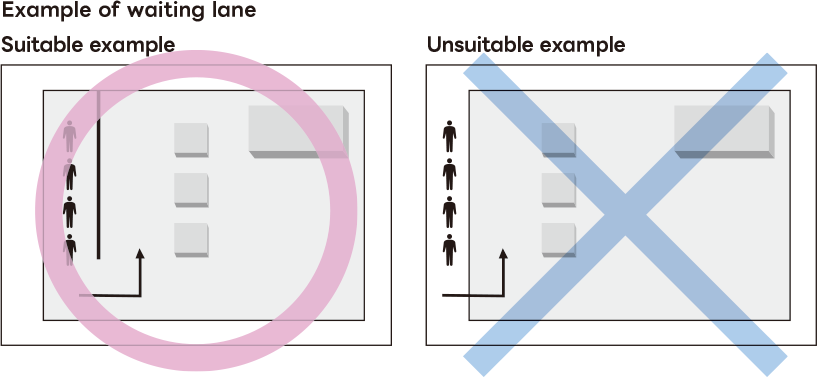
- Any presentations using the aisles around the booth or spaces outside the booth area are strictly prohibited. In addition, you may not use the aisles around the booth or the back of the booth to display exhibits, decorations, catalogs, equipment, plants, packaging materials, etc., or setting up waiting lines for visitors is not permitted. If the above regulations are violated, the organizing committee will confirm the violation and issue a recommendation for improvement, and exhibitors must comply with this. If no improvements are made despite repeated warnings, we may charge you for the space you are using.
Click image to enlarge - Projecting lights onto the aisles, walls or ceiling of the venue is prohibited.
- Setting up stages and video equipment
If you are setting up a stage or video equipment in your booth for product presentations, etc., please make sure to provide sufficient viewing space inside the booth so that visitors do not linger in the aisles. Also, please take into consideration the viewing angle and appropriate viewing distance for visitors depending on the height of the stage and video equipment. If a problem occurs at the venue, we may request that it be improved.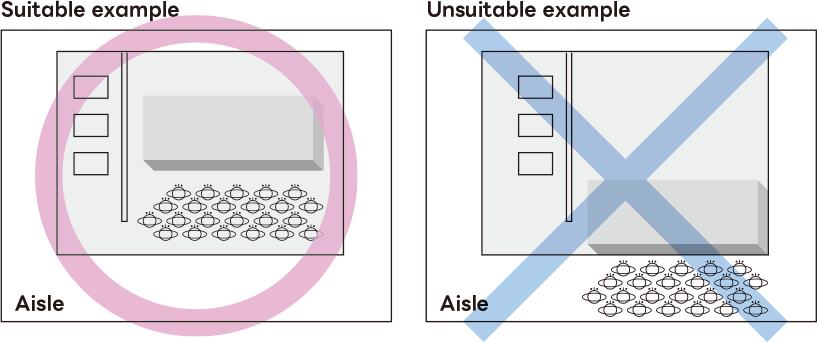
Click image to enlarge - Restrictions on speaker positioning
It is prohibited to point loudspeakers or other sound amplification equipment directly at neighboring booths. Please ensure that they are positioned facing inward from the front of the aisle. When installing speakers on walls or pillars, the center axis of the speaker must be positioned within 45 degrees vertically downward, and must not exceed the dividing line of your own booth.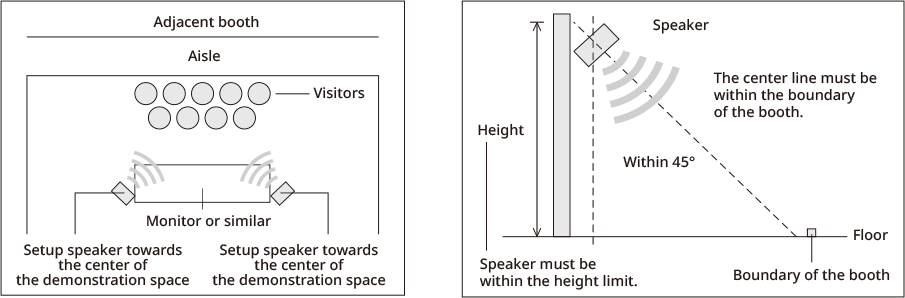
Click image to enlarge - Safety measures
- To prevent the truss and other structural pillars from falling over, please install at least four anchor bolts per pillar when securing them to the floor.
- When installing system panels (Octanorm), please take measures to prevent them from falling over, such as reinforcing the panels, reinforcing the corners with beams, and installing weights.
- Please take measures to prevent freestanding fixtures from falling over, such as securing them to the wall or floor.
- When installing video monitors, speakers, channel letters, lighting equipment, and other fixtures to be installed at high levels, please take measures to prevent them from falling over, such as securing them with bolts or wires.
- Traffic flow to neighboring booths
When designing an independent booth that is not adjacent to another company's booth of 9 booths (81㎡) or more, please design it with an open area of one-third of the side adjacent to the aisle to ensure an evacuation route in case of an emergency. - Booth space boundary line
Please consider installing carpeting or other materials in the booth space so that visitors can see the aisle and the boundary line.
6-8. Ceiling installation
If it is necessary to take measures such as light shielding or soundproofing due to the nature of the exhibits or for demonstration purposes, a ceiling can be installed using flame-retardant blackout curtains, etc., within the scope approved by the local fire department. Please note that while direct sunlight can be blocked in the venue, there is a risk of indirect light and ceiling lights reflecting.
If you wish to install a ceiling, regardless of the area, please fill in the necessary information on the application form that will be distributed in the exhibitor manual (to be distributed in July), and submit it with a floor plan, elevation plan, and construction drawings attached.
Please observe the following points when designing and constructing the ceiling.
- Structure
- You cannot install any ceiling with a structure that overlaps (double ceiling).
- All materials used for decoration must be flame retardant. Please attach a flame retardant seal to all decorative materials.
- Please submit a floor plan (showing the location and area of the ceiling) and a three-dimensional drawing (showing the ceiling and surrounding walls, etc.). Also, please clearly indicate that the ceiling is made of flame retardant materials.
- Firefighting and evacuation equipment, etc.
- Please use a fire extinguisher of Type 10 or higher.
- Automatic fire alarm equipment (smoke detectors) may be required. In this case, please install a commercial-use automatic fire alarm system and be sure to submit a notification of installation (including the results of the installation test). Please note that smoke detectors for home use are not recognized as automatic fire alarm equipment.
- Depending on the size and shape of the area, an emergency exit and emergency exit guidance light (self-illuminating type) may be required.
6-9. Two-story construction
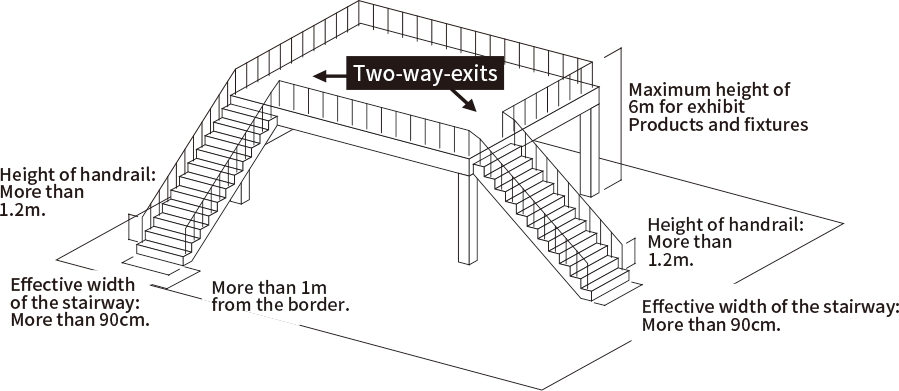
A two-story structure is a structure with a multi-story structure where there is human traffic in the upper level and the height from the floor is 2.1m or more. However, even if it is 2.1m or less in booth construction, if the lower level is used as a passageway, for exhibiting exhibits, or as a waiting room, etc., it is considered a two-story structure.
Approval from the local fire department is required for the installation of a two-story structure.
If you are planning to install a two-story structure, please fill in the necessary information on the application form that will be distributed in the exhibitor manual (to be distributed in July) and submit it with the construction drawings attached.
Please observe the following points when designing and constructing your structure.
- Eligible booths for installation
Only exhibitors with 20 or more booths (block booths) are eligible to install two-story structures. - Floor area of the second floor
The maximum floor area for the second floor is limited to half of the exhibition area. - Height of two-story structures
The height of exhibits and decorations is limited to 6m, the same as the standard booth height, so please ensure that any two-story structures you use are no more than 6m high. - Use of the second floor
Please use the second floor for product displays, business meeting rooms, waiting rooms, operation rooms, etc. Please install the second floor at least 1m away from the inside of the aisle. However, demonstrations to visitors on the first floor from the second floor are prohibited. - Design
When designing a two-story structure, please calculate the weight of the second floor (including the maximum number of people expected to be there) and refer to the diagram below. Ceiling structures are not permitted in two-story structures.- The structure must be made of steel (aluminum trusses are also acceptable) and designed to be safe, taking into account the weight of the second floor and the earthquake load during a major earthquake.
- Please submit the structural calculation documents. The exhibitor is responsible for setting the design conditions. * The submission of structural calculation documents does not guarantee safety by the organizer, facility, or fire department.
- When submitting the documents in the exhibitor manual distributed at a later date (July), please be sure to fill in the structural designer section.
- Please install a passageway of at least 90cm in two directions or more.
Click image to enlarge - Fire Prevention and evacuation facilities, etc.
Please install automatic fire alarm and fire extinguishing equipment in accordance with the following details for two-story structures.- Automatic fire alarm and fire extinguishing equipment must be installed in two-story structures. In addition, a fire extinguisher (Type 10) must be installed on the second floor.
- When installing automatic fire alarm equipment (smoke detectors), be sure to submit a notification of installation (including the results of the installation test) to the CEATEC Management Office. Note that smoke detectors for home use cannot be installed.
- Automatic fire alarm equipment (smoke detectors) must be installed in at least one location per 150㎡ of ceiling surface on the first floor. However, if the space is separated by a drop ceiling or other structure at least 60cm high, then at least one detector must be installed in each such space.
- If the floor area of the second floor exceeds 200㎡, the automatic fire alarm equipment (smoke detectors) installed on the second floor must be connected directly to the integrated management center. There may also be other instructions regarding the installation of fire extinguishing equipment, etc., so please consult with us as soon as possible.
- In accordance with the Fire Prevention Labeling System of the Fire Defense Law, the use of plywood, fiberboard, carpets, curtains, tablecloths, and banner flags for display is prohibited unless they are affixed with a fire-resistant label.
- If the floor area of the second floor is 100m² or more, please place a fire prevention manager (qualified person) in the booth.
6-10. Ceiling-suspension Configuration
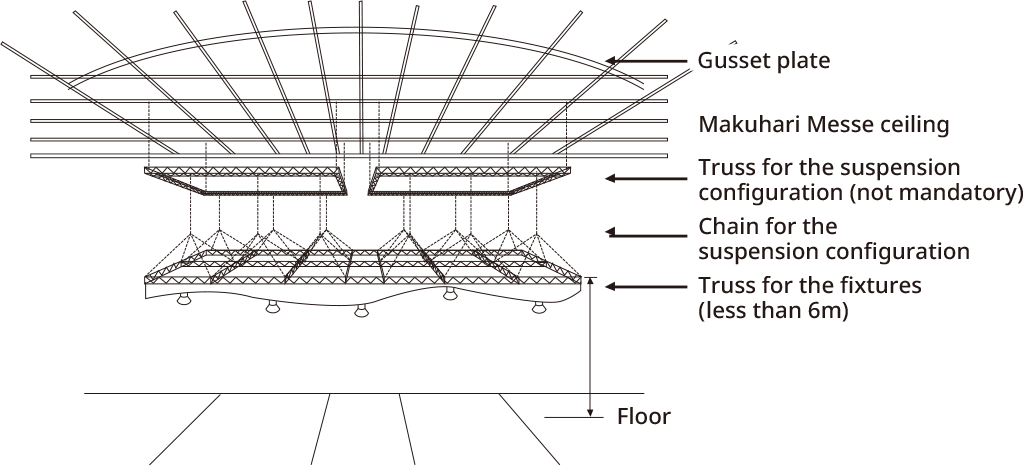
A suspended ceiling structure is a method of constructing and displaying booths in which decorations are suspended from the venue's structural ceiling using chains. If you wish to use a suspended ceiling structure, please fill in the necessary information on the application form that will be distributed in the exhibitor manual (to be distributed in July), and submit it along with a structural weight calculation sheet, floor plan, and elevation drawing.
- Applicable booths for installation
Only exhibitors with 20 booths or more (block booths) can install suspended structures. - Suspension position restrictions
The structure must be within the vertical line from the inside of the booth, but even if it is within the size limit, there may be cases where we ask you to change the position of the hanging structure due to the location of the water guns in the venue, etc. - Restriction on the point of suspension
The point of suspension is, in principle, only the gusset plate. If you wish to install it in a place other than that (such as a large beam), please consult with us as soon as possible. Please be sure to follow the instructions, as we may ask you to change your plans depending on the weight. - Weight limit
The weight limit for each gusset plate for hanging objects is 450kg or less. Please attach a drawing to the submitted plans that clearly shows the weight of each gusset plate, as well as a weight calculation table for each point. Please note that we will not be able to grant permission for installation if the drawing shows the total weight of the hanging structure divided by the number of hanging points. - Height limit
Items that are considered to be decorative (metalwork, woodwork, signs, lighting equipment, speakers, banners, cloth, etc.) should be kept below 6m, as with the height limit. However, hanging structures, trusses, chain motors boxes are not subject to height restrictions, but please install them in a position that does not obstruct the view of surrounding exhibitors. For safety reasons, please install chains for hanging decorative trusses within approximately 1 meter above the decorative trusses. In addition, any related costs incurred due to changes in plans will be borne by each company. - Other restrictions/matters to note
Please design your decorative trusses so that they form a single structure, without being divided into smaller sections.- Please take care to prevent damage to decorative trusses from the sideways shaking of an earthquake, and ensure that decorative items that rise from the floor are not joined together and fixed in place.
- Please take care to prevent cables and other wiring that cross from the floor to the decorative trusses from breaking due to the sideways shaking of an earthquake, and install them with a generous amount of slack.
- When attaching video monitors, speakers, channel letters, lighting, etc. to the decorative truss, please take measures to prevent them from falling, such as securing them in place with bolts or wires.
- Please use only inconspicuous colors such as black or gray for truss and other components.
- The exhibitor who has installed the ceiling-suspended structure booth shall be held fully responsible for any accidents that occur during the construction work or during the exhibition period due to the suspended structure.
- When selecting your booth location, the exhibition layout provided by the Association will clearly indicate the sections where ceiling suspension structures are possible. If you select a section that is not suitable for a ceiling suspension structure and you go ahead with the installation, you will be responsible for any costs incurred.
6-11. Floor Construction Work
If you wish to carry out floor work, please fill in the necessary details on the application form provided in the Exhibitor's Manual (to be distributed in July) and submit it with the construction drawings attached. Please also observe the following points regarding construction work.
- Floor construction work
- On the day of construction, please be sure to inform the CEATEC Management Office of the actual number of anchor bolts to be used before starting work. If your booth design does not require anchor bolts, please inform the CEATEC Management Office to cancel them.
- The use of concrete nails and dry pits is prohibited. Anchor bolts cannot be driven into pit covers.
- To prevent the collapse of trusses and other structural pillars, please use at least four anchor bolts per pillar when securing them to the floor.
- If you wish to lay carpet in your booth, please use double-sided tape. Gluing is not permitted.
- Restoration (recovery)
After the exhibition, the floor surface must be completely restored to its original state. If the head of the anchor bolt is protruding above the floor surface, it must be cut flush with the surface using a sander. Hammering, gas cutting, and pulling out of the anchor bolts are not permitted. If the restoration is deemed to be insufficient after the final on-site inspection, or if the restoration is not completed within the specified period and the Association is forced to carry out the work on the exhibitor's behalf, the exhibitor will be responsible for all costs incurred. - Floor Restoration Cooperation Fee
Regardless of the thickness, exhibitors will be charged a flat fee of 1,100 yen (including consumption tax) per anchor bolt for the floor restoration cooperation fee.
6-12. Fire Prevention Regulations
During the construction period and during the exhibition period, there will be an inspection by the local fire department. If the inspection finds that the following regulations have been violated, the construction may be halted or the building may be ordered to be demolished, so please observe the following regulations.
- When attaching thick cloth or pleated paper to fire-resistant plywood, please use materials that have fire-resistant properties. However, it is acceptable to use thin processed paper or cloth that is attached to the fire-resistant plywood.
- Please use flame-retardant materials for stage curtains, curtains, plywood for display, fiberboard, fabric blinds, blackout curtains, artificial flowers, carpets and other floor coverings, construction tarpaulins used during construction, and other items. Please attach a flame-retardant label to each of these flame-retardant items in a place where it can easily be seen, or attach it using a label or other method.
- Do not use Hong Kong flowers, urethane, acetate, polyester, nylon, etc., as it is difficult to give them flame-retardant properties.
- The use of styrene foam is not permitted at all. Please use flame-retardant materials that do not fall under the category of designated flammable materials under the Fire Service Act, such as Styrofoam.
6-13. Prohibition of the display, etc. of imitation goods and counterfeit goods
- The exhibition, distribution, or screening of items that infringe on the intellectual property rights (including, but not limited to, patent rights, trademark rights, design rights, and copyrights, as well as rights in foreign countries) of third parties (so-called imitation products and counterfeit products) is prohibited, as is any other action.
- If the Organizing Committee or the Association judges that the exhibits or other items fall under the category of counterfeit goods or there is a high possibility that they do, it shall be able to take measures such as removing the items in question at its discretion. In addition, the exhibitor shall not object to such measures.
- Exhibitors shall cooperate with any investigation conducted by the Organizing Committee or the Association regarding whether or not the exhibits or other items are counterfeit or imitation products.
- Exhibitors shall be responsible for resolving any disputes regarding intellectual property rights related to the exhibits.
6-14. Comparative Display
In principle, when making the following comparative displays, exhibitors should compare their own products, products, technologies, etc. with those of their own company and related group companies. If exhibitors wish to make comparative displays comparing their own products, products, technologies, etc. with those of other companies, they must obtain the permission of the other company in question and ensure that their display does not cause any problems for the other company. If the Organizing Committee or the Association finds that an exhibitor has made a display in violation of this rule, it will request that the exhibitor either stop the display or make improvements. The organizers, the Organizing Committee and the Association will not compensate exhibitors for any losses incurred as a result of such requests. Furthermore, if it is judged that sufficient measures have not been taken in response to a request for improvement, the exhibitor may be refused permission to exhibit at future events.
- Comparative displays using exhibits and demonstrations
- Comparative displays using explanatory panels, pamphlets, etc.
- Comparative displays using narration, etc.
- Other comparative displays related to products, goods, technology, etc.
6-15. Appropriate displays
The following are recommended for various types of displays in exhibition booths.
- Safety and warning labels
We recommend that you thoroughly design your exhibition booth to be safe, and that you display appropriate safety and warning labels on your displays. - Displaying the environment in which the product is used
When displaying products, please display them in a way that is based on the actual environment in which the product is used, and take care not to give the impression of "excessive expectations" or "false impressions of quality".
If your display is different from the actual environment in which the product is used, we recommend that you display a notice to that effect.
6-16. Ceiling lighting
The lighting in the exhibition halls is 300 to 375 lux (in Halls 1 to 6, 450 to 500 lux is provided by all mercury lamps, and in Halls 7 and 8, 450 to 500 lux is provided by 75% LED lighting). Please note that the lighting may vary depending on the location and environment.
6-17. Audio Volume Restrictions
If you are planning to install audio equipment in your booth, please discuss this with neighboring exhibitors in advance and check the volume so as not to cause any inconvenience to them. If you are planning to use audio equipment for presentations, etc., please try to limit the time as much as possible, and discuss with neighboring exhibitors the volume of the presentation microphone and the time. If there is an emergency broadcast, please stop the sound immediately.
- Volume Restrictions
Maximum: 80 dB - Volume Measurement
- In principle, the volume measured at a distance of 2m from the booth boundary will be used as the standard.
- The measurement device used will be a sound level meter that conforms to JIS C 1509, and the standard will be the measured peak value.
- During the exhibition, the Association will carry out regular volume measurements, but exhibitors are also requested to carry out their own volume measurements on the day before the exhibition opens and during the exhibition. The Association will also provide volume measurement devices, so please ask if you need one.
- Actions to be taken against exhibitors who violate the volume regulations
Exhibitors who are found to be exceeding the volume limit through the volume measurements taken by the Association, or who are emitting low-frequency sounds that have a significant impact on the surrounding area, will be asked to make improvements, and exhibitors must comply with these requests. Even if the volume is within the above-mentioned regulations, if the sound is clearly unpleasant and complaints are received from neighboring booths or visitors, improvements will be requested.
The following penalties will be applied to exhibitors who do not make improvements:- If the improvement recommendation is issued for the third time in total: the use of audio equipment will be prohibited in the morning of the following day.
- Resident Operation Manager
The person in charge of operating the sound system must be present in the booth at all times to ensure that the system is operated in accordance with the regulations.
6-18. Demonstration Regulations
- Copyright Processing
If you are playing music or playing back audio/video recordings at your exhibition or demonstration, you will need to take care of the copyright. (If you own the rights to the music/recordings and have already taken care of the copyright separately, this is not necessary.)
For information on how to handle this, please contact the Japan Society for Rights of Authors, Composers and Publishers (JASRAC) or other organizations that have been entrusted by the rights holders to handle matters related to the exercise of rights. - Light and lighting
It is not permitted to shine lights or other devices on the aisles outside the booths or on the venue structure. If you are using LED or other devices with strong light power for displays or signs, please take care to install them in a way that does not cause any problems for neighboring exhibitors or visitors. Please be aware that if a problem arises at the venue, you may be asked to make improvements. - Smoke machines
The use of smoke machines (those made from alcohol, oil, or other petroleum-based materials, or those using carbon dioxide, dry ice, etc.) for stage effects is prohibited. - Other
Please take precautions in advance to prevent the following items, which may be generated by demonstrations, from causing problems for other exhibitors and visitors.
① Heat ② Gas ③ Odor ④ Vibration
6-19. Handling of Dangerous Goods
- Prohibited acts
The following acts are prohibited in the exhibition hall under the Fire Defense Law.
① Smoking
② Use of naked flames (including devices that generate sparks and exposed electric heaters)
③ Bringing in flammable gases such as liquefied petroleum gas
④ Bringing in hazardous materials (gasoline, kerosene, machine oil, heavy oil, etc.)
⑤ Bringing in dangerous goods (explosives, large quantities of matches, large quantities of disposable lighters, etc.) - Exemption from Prohibited Activities
With the exception of smoking, items related to the above prohibited activities may be brought into the venue under certain conditions, limited to the minimum amount necessary for the demonstration of exhibits, and subject to permission from the competent fire department. Exhibitors who wish to apply for an exemption from these prohibitions must fill out the required information on the application form provided in the Exhibitor Manual (to be distributed in July), and submit it along with two copies of a catalog or a document explaining the demonstration setup. The Organizer will submit a collective application to the fire department on behalf of the exhibitors. Only items that have received approval may be brought into the venue.
6-20. Violations of these regulations and questions regarding interpretation
The following shall apply in the event of a violation of these regulations by an exhibitor or in the event of a question regarding the interpretation of these regulations. The Japanese version of these regulations shall take precedence in the event of any discrepancy in interpretation.
- In the event that the Organizing Committee determines that an exhibitor has violated the Exhibition Regulations with regard to the exhibitor's booth or the manner in which it is operated, the Association shall request that the exhibitor make improvements.
- If the exhibitor does not make improvements after being asked to do so twice as per (1) above, or if there is any doubt about the interpretation of these regulations, the Executive Committee will discuss how to deal with the situation and, based on its final decision, order the exhibitor in question to make improvements. The conclusion reached through this discussion will be the final decision, and the exhibitor will not be able to file an objection or claim for damages.
- Exhibitors who have been asked to make improvements as per (2) above must submit a written report to the Association on the same day, detailing the improvements to be made and the schedule for making them.
- If the exhibitor who has been asked to make improvements as per (2) above fails to take the measures and make the improvements as per (3) above, or if the Organizing Committee deems the improvements to be insufficient, the following penalties may be applied.
① Prohibition of demonstrations and exhibition activities from the following day onwards.
② If the exhibitor does not comply with the above-mentioned penalty, the fact will be made public and the exhibitor may not be allowed to exhibit at the next CEATEC.
6-21. Others
- Regulations and restrictions other than those in these exhibition regulations will be clearly stated in the "Exhibitor's Manual" to be distributed in July, so please comply with them as well.
- Payment by bill is not accepted for all expenses, including the exhibition fee.
- The organizer, the Organizing Committee and the Association may change part of these regulations if they deem it necessary. In such cases, the revised regulations will be announced to exhibitors on the CEATEC JAPAN official website and by other means.
- Exhibitors shall comply with the laws and regulations of Japan, and the organizer, the Organizing Committee and the Association shall not be held liable for any violation of the laws and regulations by exhibitors.
6-22. Organizing Committee
The Executive Committee is an organization made up of representatives of exhibitors that deliberates and decides on matters related to the operation of the exhibition, such as rules and plans. During the preparation period and the exhibition period, the Executive Committee members will be stationed at the venue at all times, and will be responsible for maintaining the exhibition environment, handling problems, ensuring that the exhibition rules are followed, and having the authority to deal with any problems that occur.
General Exhibits RegulationsPDF Download